
By Juan Ignacio Baldrich · · Leer en español
The term Dark social refers to the traffic that arrives at a website from private conversations that analytics tools classify as direct traffic or fail to record entirely, such as a WhatsApp chat, an Instagram direct message or a Slack channel. Many of the strongest recommendations take place inside those private conversations, yet traditional analytics reports leave them completely invisible.
Book a Strategy Call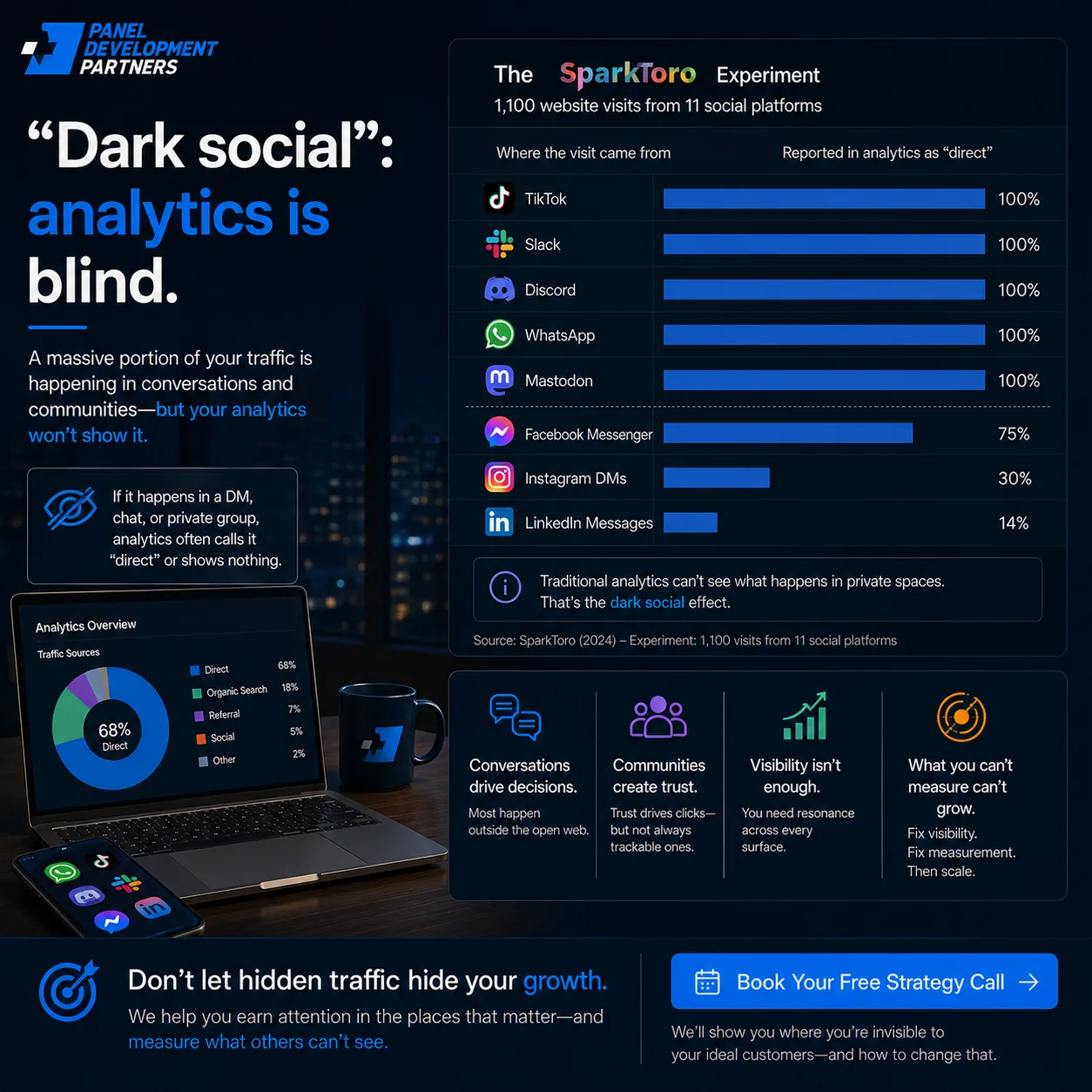
Journalist Alexis Madrigal introduced the term in The Atlantic in October 2012. While analyzing digital audience data with Chartbeat, a firm that tracks web traffic, he uncovered a significant blind spot. Nearly 57% of the visitors referred to the publication did not come from public social media networks like Facebook or Twitter. Instead, they arrived through links shared in private emails and direct text messages. When Chartbeat examined other major publishers, that number rose to 69%.
The mechanism behind this is very simple. When a user clicks a link within a public social network, the browser transmits a digital referrer tag that informs the destination website where the visitor came from. When someone copies that link and pastes it into WhatsApp, a text message or an email, that tracking information is stripped away completely. Because the analytics software cannot identify the true source, it defaults to recording the visit as direct traffic.
Google Analytics 4 defines direct traffic as visits from users who type a web address into their browser or click a saved bookmark. However, Google's technical documentation confirms that this category also acts as an unassigned catchall. Any visit missing attribution data ends up here, including links shared in private messages, clicks inside PDF documents and traffic passed through link shorteners or redirects that erase the origin data.
In April 2023, SparkToro cofounder Rand Fishkin published the findings of an industry field study conducted alongside the data firm Really Good Data. Over ten consecutive days, a testing panel of roughly one hundred participants clicked on live links distributed across eleven social networks and five private messaging channels. The team tracked 1,113 total website visits simultaneously inside Google Analytics 4 and its predecessor, Universal Analytics.
The objective: to determine what percentage of those visits retained accurate referral data and how many were misclassified as direct traffic. The results revealed that standard web analytics tools misread incoming traffic far more frequently than most marketing executives realize:
| Where the visit came from | Reported as direct |
|---|---|
| TikTok, Slack, Discord, Mastodon and WhatsAppNo visit kept its source data | 100% |
| Facebook Messenger | 75% |
| Instagram direct messages | 30% |
| Public LinkedIn posts | 14% |
| Public Pinterest posts | 12% |
At the other end, YouTube, public Facebook posts and tweets kept their source data in most or all cases. LinkedIn and Twitter direct messages and Reddit posts lost a smaller share. As the title of the study puts it, dark social falsely attributes significant percentages of web traffic as "direct."
Critical decisions are rarely made in public view. Before selecting a physician, an attorney or a financial advisor, prospective clients turn to trusted personal circles: family members, close friends or workplace peers. Those conversations take place in private messaging threads rather than in public social media feeds. As established in an earlier analysis, a firm makes its true first impression within those private discussions long before a prospective client ever visits its website.
Within the Hispanic market, those conversations often occur on WhatsApp. Data from the Pew Research Center reveals that 56% of Hispanic adults in the United States use WhatsApp, compared with 24% of non-Hispanic white adults. This demographic represents the platform's most active user base nationwide.
For a South Florida firm serving this community, the commercial implications are direct. A substantial share of high-intent referrals arrives through the very channel that standard analytics cannot monitor. A prospective client receives a recommended link inside WhatsApp, browses the site and places a call or submits an inquiry. The reporting software that businesses rely on categorizes that interaction as direct traffic, or fails to capture the attribution entirely.
This blind spot carries strategic consequences beyond flawed metrics. When leadership allocates marketing capital based strictly on digital attribution reports, organizations inadvertently over-fund the final measurable click. In doing so, they cut investment in the assets that actually drive client acquisition: institutional reputation, peer relationships and sustained presence within community conversations.
Dark social never appears by name in any report, but it leaves traces. The table shows the most common ones, what they usually indicate and what happens when they are misread.
| Signal | What it usually indicates | Risk if misread |
|---|---|---|
| Direct traffic to inner pages with long URLs | Nobody types that address by hand: someone shared the link | Crediting it to customers who already knew the brand |
| Spikes in direct traffic after a post or a newsletter | The content circulated in private messages | Concluding that the post did not work |
| More searches for the business name in Search Console | Someone talked about the business outside Google | Crediting the growth only to SEO |
| Calls and WhatsApp messages with no clear source | Word-of-mouth recommendations arriving by chat | Cutting investment in reputation and community |
| Customers who say "someone recommended you" | The real acquisition channel | Not asking and losing the data |
| Customers who arrive with their decision almost made | Trust was built before the first click | Measuring the business only by the last click |
At Panel Development Partners we read analytics together with calls, forms, branded searches and Google Business Profile actions, because part of the customer journey happens where no tool can reach.
Dark social cannot be eliminated, because it reflects the organic way human beings share what matters to them. However, company leaders can systematically shrink the blind spot through practical operational steps:
What is not measured cannot grow. With dark social, the main challenge is not a lack of actual business results but a lack of visibility into where those results originate. The correct operational sequence is simple: secure organic visibility, establish accurate measurement methods and then deploy capital to scale.
For this reason, we evaluate an organization's market presence well beyond standard digital analytics reports. We assess institutional reputation, visibility within generative artificial intelligence search environments, local prominence across the Google Business Profile and the peer networks where trusted recommendations occur. We apply this exact methodology to TuSeguroMedico.com, our own health insurance brokerage firm, before deploying it across the healthcare, legal, financial and professional services practices we advise. Private conversations shape high-stakes commercial outcomes far more than surface metrics reflect. The competitive advantage belongs to the firms that build the discipline to measure and influence those conversations.
The figures and quotes in this insight come from the following public sources, which the reader can consult directly:
Information verified on October 31, 2026. The SparkToro figures come from a controlled experiment with a panel of participants; the real share for each business depends on its audience and its channels.

Panel Development Partners was founded by Juan Ignacio Baldrich. With more than fifteen years of experience in the health insurance industry, he has built his career at the intersection of health plans, independent insurance agencies and healthcare providers, developing a deep understanding of how each stakeholder contributes to sustainable market growth.
During his final years at Aetna, one of the nation's largest health insurance carriers, Juan worked exclusively with some of the company's highest-producing insurance agencies. His role focused on strengthening strategic relationships between agents, independent physician practices, large medical groups, provider organizations and sales leadership across multiple health plans, helping align business objectives and create long-term value for all parties involved.
Before founding and expanding his own independent agency, Juan served as Chief Provider Strategist, working directly with independent physicians, medical groups and Independent Practice Associations (IPAs). That experience provided him with a thorough understanding of fee-for-service and risk-based reimbursement models, provider panel growth, network development and the strategies that enable insurance agencies and healthcare providers to build sustainable, mutually beneficial partnerships.
An insurance agent licensed in Florida since 2010 (2-15 License P230623, NPN 15714451), he combines firsthand industry experience with expertise in SEO, local search and content strategy for businesses in fields where accuracy and trust are essential.
Book a free strategy call and we'll show you where you're invisible to your ideal customers and how to change that.