By Juan Ignacio Baldrich ·
Google still carries three out of four searches. One in five now happens somewhere else and the people deciding on a physician, an attorney or an insurance plan use all of those places in sequence. The Datos and SparkToro data explains why visibility can no longer be planned one channel at a time.
Book a Strategy Call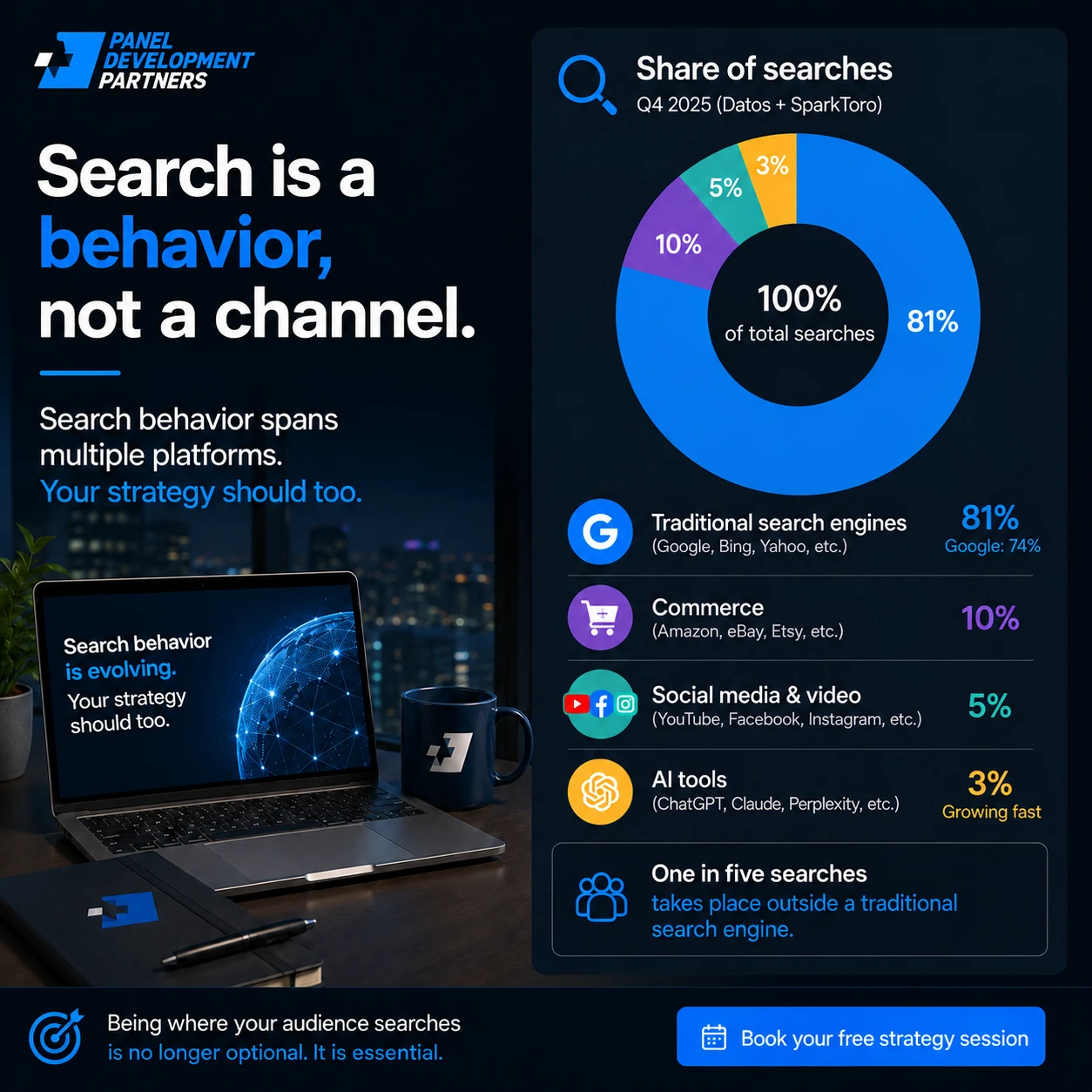
Most businesses still treat search as an isolated line item. They assign one budget to Google Ads, another to SEO (at best), review a monthly report tracking arrivals through each channel. Underlying this framework is the assumption that search operates as a single destination where consumer demand lives, waiting to be either bought or earned.
The reality of user behavior no longer aligns with that premise. An individual choosing a physician, an attorney, an accountant or an insurance plan never conducts just one inquiry. Instead, they navigate a sequence across multiple platforms, relying on each unique space to resolve a specific type of question. Given the data currently available on user journey locations, this shift in behavior has become impossible to overlook.
In March 2026, SparkToro released an analysis examining search behavior across 41 digital destinations, drawing from the desktop clickstream panel managed by Datos, a Semrush company. Because this dataset tracks millions of American devices throughout the entirety of 2025, the fourth quarter category shares provide the clearest, most comprehensive public view of modern search distribution.
| Platform type | Share of searches | Examples |
|---|---|---|
| Traditional search enginesGoogle alone: 74% | 81% | Google, Bing, Yahoo, DuckDuckGo |
| Commerce platforms | 10% | Amazon, Walmart, eBay, Booking |
| Social and video platforms | 5% | YouTube, Facebook, Instagram |
| AI toolsGrowing fast | 3% | ChatGPT, Perplexity, Claude |
Google by itself represented 73.7% of all desktop searches across the 41 analyzed domains, keeping traditional search engines at roughly four out of every five queries. Meanwhile, commerce hubs captured approximately 10%, social and video networks drew 5.5% and artificial intelligence tools reached 3.2%.
Two specific shifts within these numbers carry far more significance than the broad categories. Throughout 2025, Google dropped 3.5 share points across top digital properties, while Amazon, Bing and YouTube each saw steady gains. Even more revealing, Amazon, Bing and YouTube each recorded greater individual search volume than ChatGPT. The very platform driving the conversation about where search is heading remains smaller than three legacy channels that standard marketing plans routinely treat as afterthoughts.
This study contains one vital structural boundary: it reflects desktop browser activity alone. Native mobile apps, which absorb an enormous portion of modern social, video and retail browsing, are entirely absent from the dataset. Consequently, the volume of discovery unfolding outside of Google is almost certainly understated.
The first interpretation is the comfortable one. Google remains the center of gravity. Three out of four searches still begin there and any strategy that abandons Google in favor of newer platforms is abandoning the majority of demand. That reading is correct.
The second interpretation, however, fundamentally alters strategy. One in five queries never reaches a traditional search engine at all. Far from a marginal fringe, that slice exceeds the entire combined audience of most regional media outlets and it continues to climb as Google loses ground.
Any business visible solely within Google remains entirely absent from fully twenty percent of the moments when prospective buyers seek its solutions.
These two perspectives capture the exact same user journey. A potential client first enters a medical condition into Google, watches a specialist break down the diagnosis on YouTube, prompts an artificial intelligence model to contrast two specific treatment paths, examines patient reviews on Google Maps and finally asks a private messaging group if anyone has personal experience with the practice. No single provider controls that pathway. Every step serves as an independent checkpoint and at every checkpoint, a business either stands ready with credible authority or vanishes from consideration altogether.
In healthcare, legal, financial and professional services, the research phase preceding a commitment is significantly longer and far more rigorous than in typical retail categories. Google classifies these sensitive topics as Your Money or Your Life, evaluating the material addressing them against strict benchmarks of experience, expertise, authoritativeness and trust. Prospective clients independently enforce the very same scrutiny. They cross verify every single claim.
For that reason, the market shares across these discovery channels must never be treated as simple volume weights. Missing visibility on a platform that commands 5% of overall searches does not represent a minor 5% exposure issue. It creates a broken checkpoint inside a fragile sequence that must remain unbroken for the client to choose your practice. A professional firm supported by an authoritative website yet lacking video assets faces a critical void precisely when a cautious prospect seeks visual proof. The same vulnerability hits a business boasting flawless client testimonials but offering zero structured authority when an artificial intelligence assistant compiles a comparative evaluation against a competitor.
Generative artificial intelligence platforms demand distinct strategic consideration. While a 3.2% query share reflects modest overall volume, the underlying commercial intent is exceptionally concentrated. As highlighted in our previous review, Semrush reported in 2025 that traffic originating from artificial intelligence discovery converted at 4.4 times the rate of standard organic search visits, precisely because these users arrive at the finish line having already weighed their alternatives. A compact share of overall inquiries can easily dictate an overwhelming share of final decisions.
Each platform answers a different question for a careful buyer. The table shows what is being verified at each stop and what happens when the business has nothing there to verify.
| Platform | What the client verifies there | If the business is absent |
|---|---|---|
| Google Search | Who you are, what you do and whether your content answers the question | A competitor's page becomes the reference |
| Google Maps and Business Profile | Location, hours, reviews, photos and how you respond to criticism | The decision moves to the practice with two hundred reviews |
| YouTube and social video | Whether the professional can explain the problem in their own words | Someone else's explanation sets the expectations |
| AI assistants | A comparison of options, with sources the assistant can cite | The summary is written from whatever the model found, without you |
| Directories and review platforms | Credentials, third-party opinions and consistency with everything else | The business does not exist in the comparison |
| Private conversations | What a friend, colleague or group chat says about you | Nothing to forward and no profile to share |
At Panel Development Partners we measure presence at every one of these checkpoints for our own insurance brand before we recommend anything to a client.
The wrong lesson to draw from fragmented search behavior is that a business must post everywhere at all times. Checkpoints do not reward sheer volume; they reward consistency.
At every stop, a careful buyer verifies the exact same facts: who runs the company, what credentials they hold, whether past clients had good outcomes, whether the business addresses key questions and whether that narrative remains uniform from Google to YouTube to an AI summary. A profile stating one message, a website stating another and an empty review footprint does not create fragmented visibility. It creates contradictory visibility and contradictions are precisely what discerning buyers spot first.
Presence simply means a business makes its expertise verifiable wherever prospects search, in the native format of each platform, with identical facts throughout.
Our perspective comes directly from operating our own insurance brand, TuSeguroMedico.com, in one of the most competitive health insurance markets in the country. Health coverage represents a textbook trust decision. Consumers evaluate options in the precise sequence described above and we witness firsthand the direct impact of being present or absent at every single step.
We view search as an evolving consumer behavior and evaluate our visibility accordingly across standard Google organic listings, the local map pack, educational video assets, artificial intelligence syntheses and the client reviews that fuel private word of mouth. The corporate website serves as the ultimate anchor because it remains the singular digital property where a company maintains full authority over its story and credentials. Every external asset must align with that foundational source.
We established this standard within our own company before deploying it across the healthcare, legal, financial and professional services firms we advise. The data highlighted above offers unambiguous proof of why this holistic approach is essential.
The figures in this insight come from the following public sources, which the reader can consult directly:
Information verified on October 18, 2026. The Datos panel measures desktop browsers in the United States; mobile apps are outside the data.

Panel Development Partners was founded by Juan Ignacio Baldrich. With more than fifteen years of experience in the health insurance industry, he has built his career at the intersection of health plans, independent insurance agencies and healthcare providers, developing a deep understanding of how each stakeholder contributes to sustainable market growth.
During his final years at Aetna, one of the nation's largest health insurance carriers, Juan worked exclusively with some of the company's highest-producing insurance agencies. His role focused on strengthening strategic relationships between agents, independent physician practices, large medical groups, provider organizations and sales leadership across multiple health plans, helping align business objectives and create long-term value for all parties involved.
Before founding and expanding his own independent agency, Juan served as Chief Provider Strategist, working directly with independent physicians, medical groups and Independent Practice Associations (IPAs). That experience provided him with a thorough understanding of fee-for-service and risk-based reimbursement models, provider panel growth, network development and the strategies that enable insurance agencies and healthcare providers to build sustainable, mutually beneficial partnerships.
An insurance agent licensed in Florida since 2010 (2-15 License P230623, NPN 15714451), he combines firsthand industry experience with expertise in SEO, local search and content strategy for businesses in fields where accuracy and trust are essential.
Book a free strategy call and we will show you where your business is visible today, where it is absent and which gaps matter most for the decisions your clients are making.
