By Juan Ignacio Baldrich ·
Impressions climb while clicks fall: in Google Search Console the two lines pull apart like the open jaws of an alligator. It is not a problem with your content. It is a structural change in how Google and artificial intelligence answer questions before anyone visits a website.
Book a Strategy Call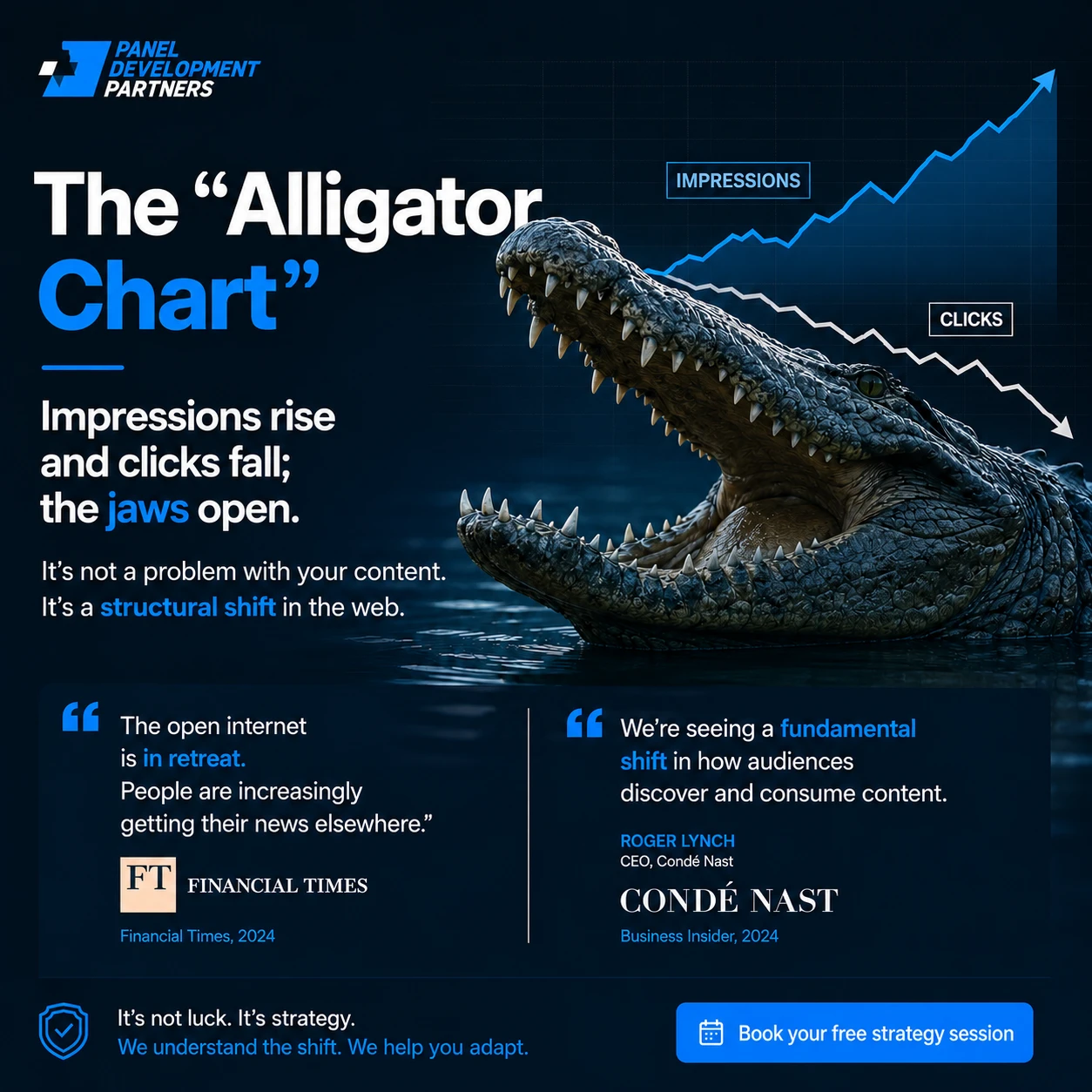
For years, the two main lines in Google Search Console moved together. When a site appeared more often in search results, it received more visits. Impressions and clicks rose and fell at the same pace. Click-through rate, the ratio between them, stayed relatively stable.
Since May 2024, when Google rolled out its AI-generated answers (AI Overviews) in the United States, thousands of businesses have started to see a different shape. The impressions line keeps rising because the site appears in more searches. The clicks line flattens or falls because the answer has already been delivered on the results page itself. Between the two, a mouth opens wider and wider. The industry named it the alligator chart.
The chart does not describe a mistake on the website. It describes a change in how information is consumed: the user gets the answer without leaving Google and only clicks when they need something the summary did not provide.
Four independent measurements, built with different methods, point in the same direction.
| Finding | Figure | Source |
|---|---|---|
| Clicks on a traditional result when an AI summary appearsVersus 15% when it does not | 8% | Pew Research Center, July 2025 |
| Clicks on a link inside the summary itself | 1% | Pew Research Center, July 2025 |
| Lower click-through rate for the top result when an AI Overview appearsDecember 2025 versus December 2023 | 58% | Ahrefs, February 2026 |
| Decline in visits Google sends to news publishersJuly 2025 to July 2026 | 40.2% | Chartbeat, 2026 |
| Visits AI assistants send to those same publishers | 0.01% | Chartbeat, 2026 |
Pew Research Center tracked the real browsing of 900 adults in the United States during March 2025. An AI summary appeared in 18% of their searches. When the summary was present, users clicked a traditional result in 8% of visits; without it, in 15%. In addition, 26% of sessions with a summary ended right there, compared with 16% of those that showed only traditional results.
Ahrefs analyzed 300,000 keywords using aggregated Search Console data. In December 2025, the presence of an AI Overview correlated with a 58% lower click-through rate for the page in the top position. In April 2025, an earlier study by the same firm had measured 34.5%. Ahrefs notes that the two studies compare different periods and are not directly comparable, but the direction is the same.
Chartbeat, which measures traffic for thousands of news and media sites, recorded that visits from Google Search fell 40.2% between July 2025 and July 2026, after a 21.9% decline the year before. Over the same period, AI assistants sent 0.01% of visits. What search no longer sends, chatbots are not replacing.
Large publishers were the first to feel the bite because their business model depends on visits.
Google search is "no longer a meaningful driver" of traffic to our websites.
Roger Lynch, chief executive of Condé Nast, in an interview with the Financial Times, February 27, 2026.
According to the same interview, Google went from generating the majority of visits to Condé Nast, publisher of Vogue, The New Yorker and GQ, to about 25% in 2025. The Reuters Institute's 2026 trends report records a one-third decline in Google search traffic to news publishers in the year to November 2025. The 280 media leaders surveyed expect a further average decline of 43% over the next three years.
Even Google wrote in a 2025 court filing that the open web "is already in rapid decline." The company later clarified that it was referring to open-web display advertising, not the web as a whole. The clarification matters, but the phrase captures the pressure felt by everyone who depends on the click.
The alligator chart has a trap worth knowing about. Until September 2025, many rank-tracking tools queried Google with a technical parameter (&num=100) that returned one hundred results on a single page. Each of those automated queries could be recorded as an impression in Search Console, even though no person ever saw the result.
Between September 10 and 12, 2025, Google stopped supporting that parameter and described it as a feature it had never officially supported. Desktop impressions dropped sharply for most sites and average position "improved" without anything having actually changed. An analysis cited by the consultancy Zeo found that 87.7% of sites recorded fewer total impressions.
The conclusion has two parts. The decline in clicks is real, because Pew and Chartbeat measure people, not bots. But part of the rise in impressions that opened the alligator's mouth between 2024 and 2025 was noise. Comparing periods before and after September 2025 without accounting for it leads to the wrong conclusions.
Every Search Console signal has two possible readings. The table shows what each one really indicates and what happens when it is misread.
| Signal in Search Console | What it really indicates | Risk if misread |
|---|---|---|
| Impressions rising while clicks stay flat | More presence in results that already include an answer | Cutting content that does generate visibility |
| Falling click-through rate on informational queries | The AI summary resolves the question on the results page itself | Concluding the content lost quality |
| Sharp drop in impressions in September 2025 | End of the &num=100 parameter, not a real loss of visibility | Reacting to a problem that does not exist |
| Average position suddenly improving | Deep positions dropping out of the calculation | Celebrating an improvement that never happened |
| Branded clicks stable while generic clicks fall | People already know who you are and search for you by name | Neglecting the asset most worth protecting |
| Calls and form submissions stable with fewer visits | The people who click arrive more decided | Measuring the business by traffic volume alone |
At Panel Development Partners we read Search Console alongside calls, form submissions and Google Business Profile actions, because the click is no longer the only unit of value.
In healthcare, legal, financial and professional services, the question is no longer only how many people visit the website. It is whether the business appears as a source when Google or an AI assistant answers the question and whether the person who finally clicks finds what the summary promised.
Google applies stricter standards of experience, expertise, authoritativeness and trust to these topics, which it calls "Your Money or Your Life." Generated answers are built from sources that can demonstrate those qualities. A business with verifiable authorship, visible credentials and consistent information across every platform is more likely to become the source that gets cited. One without them is left out of the answer and out of the click.
The other half of the equation is the value of the visitor who does arrive. As we explained in a previous insight, people who arrive after reading an AI answer tend to do so with their decision almost made. Fewer clicks do not necessarily mean fewer clients, as long as the business is present inside the answer.
The alligator chart will not close by publishing more or by trying to recover the traffic of 2023. It is managed by understanding what each line really measures, separating signal from noise and measuring the business by what it produces: calls, appointments and clients.
That is why we evaluate a business's visibility beyond the click: its presence in AI-generated answers, in its Google Business Profile, in reviews and in searches for its own name. It is the same standard we use to operate TuSeguroMedico.com, our own health insurance brand, before bringing it to the healthcare, legal, financial and professional services businesses we work with.
The change is structural. What depends on each business is the decision to adapt.
The figures and quotes in this insight come from the following public sources, which the reader can consult directly:
Information verified on October 23, 2026. The Chartbeat and Reuters Institute figures refer to news publishers; the Pew and Ahrefs figures refer to search in general.

Panel Development Partners was founded by Juan Ignacio Baldrich. With more than fifteen years of experience in the health insurance industry, he has built his career at the intersection of health plans, independent insurance agencies and healthcare providers, developing a deep understanding of how each stakeholder contributes to sustainable market growth.
During his final years at Aetna, one of the nation's largest health insurance carriers, Juan worked exclusively with some of the company's highest-producing insurance agencies. His role focused on strengthening strategic relationships between agents, independent physician practices, large medical groups, provider organizations and sales leadership across multiple health plans, helping align business objectives and create long-term value for all parties involved.
Before founding and expanding his own independent agency, Juan served as Chief Provider Strategist, working directly with independent physicians, medical groups and Independent Practice Associations (IPAs). That experience provided him with a thorough understanding of fee-for-service and risk-based reimbursement models, provider panel growth, network development and the strategies that enable insurance agencies and healthcare providers to build sustainable, mutually beneficial partnerships.
An insurance agent licensed in Florida since 2010 (2-15 License P230623, NPN 15714451), he combines firsthand industry experience with expertise in SEO, local search and content strategy for businesses in fields where accuracy and trust are essential.
Book a free strategy call and we will review with you what your Search Console is really saying, which part of the decline is real and where your business appears in AI-generated answers.
